

Two tokens matter in every stream. The reward token (or points) is what gets paid out. The target token is the token whose on-chain balance Turtle tracks to measure each wallet’s contribution. They are usually different. See the glossary.
What you get
For protocols
Self-serve creation from the Client Portal or the API. Pay for the TVL wallets hold or for how long depositors commit, with rate mechanics from a fixed cost per unit of TVL to gap-fill rates that only pay when native yield falls short. Audience targeting through eligibility, whitelists, and boosts. Pay in real tokens or in points that convert at a future TGE. Each stream holds its own funds and every distribution is verifiable on-chain.
For LPs
Claim on their own schedule. A single cumulative claim always pays the full outstanding balance. Rewards stack on top of the vault’s native yield. No lockup, and LPs keep custody of their position throughout.
How a stream is defined
Three choices define every stream, made in order at creation:- Reward base — what you pay with: Tokens (an ERC-20 with a market price; budgets and rates read in dollars) or Points (units of a points program; amounts read in points and convert at a future TGE).
- Reward type — what you pay for:
- TVL-Based pays by token value held. Holders earn continuously against their balance.
- Deposit-Based pays by deposit characteristics — rewarding how long depositors commit, through tiered rates that unlock at cliffs.
- Airdrop is a one-time distribution defined by a recipient list.
- Mechanic — how the rate is set within that type (Fixed APR, Fixed Rate, Daily Budget, or a gap-fill rate). See the table below.
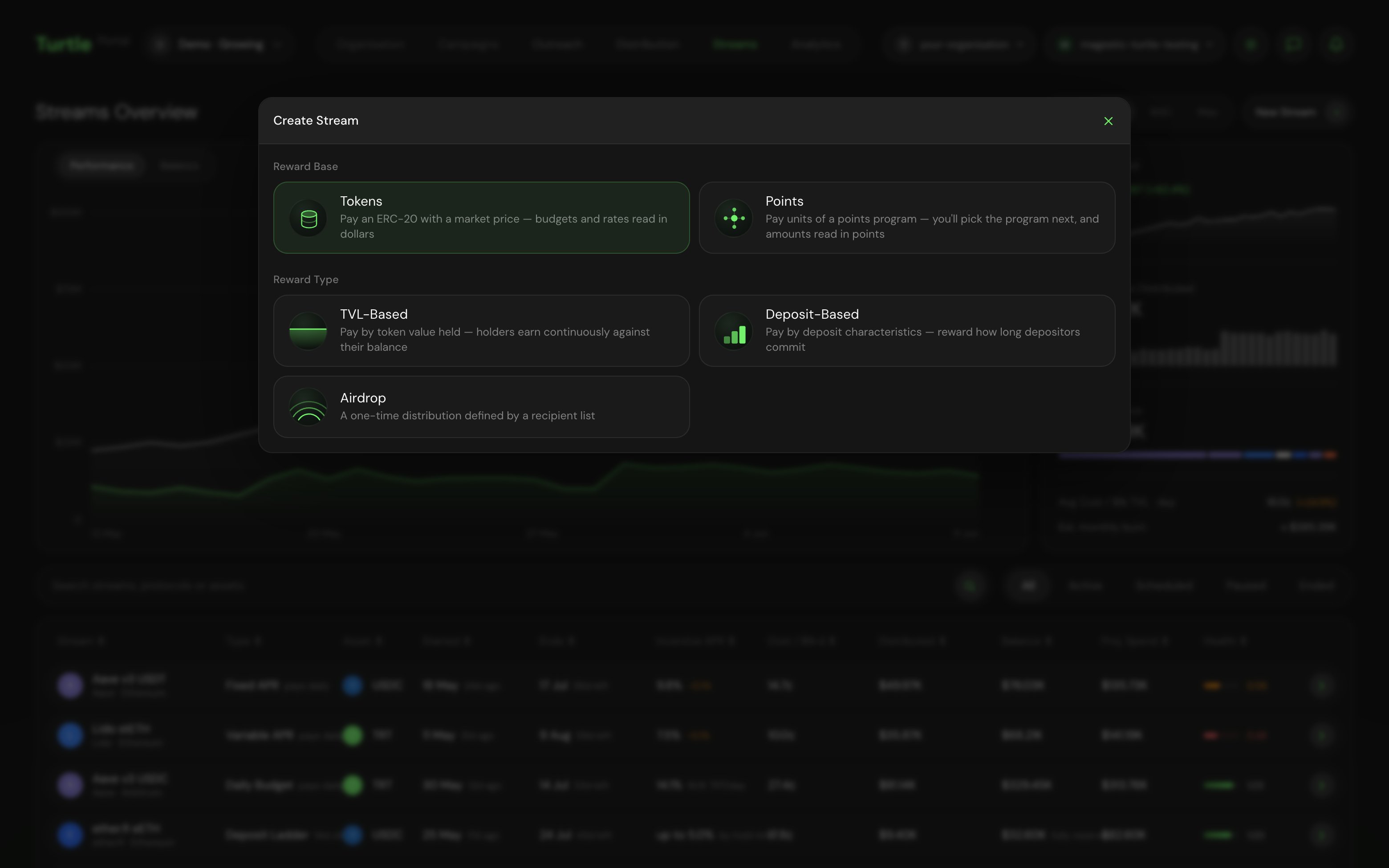
Creating a stream starts with the reward base and reward type.
You may see older names for deposit-based streams — “Deposit Vesting”, “Vesting Bonus”, or “Deposit Ladder” in older material and dashboards. They are the same thing: deposit-based streams with duration tiers. In the API, gap-fill streams are still created under the
Yield Match type; see the create-stream reference.How a stream works
1
You configure a stream
Set the reward base, reward type, mechanic, target, rate, and schedule in the Client Portal or via the API. For token streams, the Turtle backend issues a signature and your wallet submits an on-chain
createStream transaction to the StreamFactory. Point streams are created instantly, with no on-chain step.2
Turtle tracks contributions
The indexer tracks the target token balance of every holder and builds a time-series of TVL contributions. For deposit-based streams it also tracks each deposit and the route it arrived through, so eligibility can be scoped to deposits made through Turtle or through specific distributors.
3
Rewards compute about twice a day
A reward updater runs roughly twice daily and computes each wallet’s accrued rewards from its contribution and the stream’s mechanic, saved as snapshots.
4
A Merkle root is committed on-chain
The latest snapshot is committed as a Merkle root, roughly every 12 hours, which makes the distribution verifiable.
5
LPs claim
LPs submit a Merkle proof to claim. For TVL-based streams rewards accrue continuously and each commit makes newly accrued rewards claimable; for deposit-based streams rewards become claimable at each cliff. Claims are cumulative, so a single transaction always pays the full outstanding balance. Claiming can happen on Turtle, on your own front end, or automatically on the LP’s behalf. See Claiming rewards.
Rate mechanics at a glance
The mechanic decides how the per-wallet reward rate is set. Which mechanics are available depends on the reward type and base.
For deposit-based streams, the rate is set per duration tier (Fixed APR or Fixed Rate per tier today), and rewards for each tier unlock at its cliff. Point streams support the mechanics that need no token price: Fixed Rate, Daily Budget, and Airdrop. See Choosing a reward model to compare and pick.
Token streams and point streams
A stream is either token-based or point-based, never both.- Token streams pay a real ERC-20 on-chain. The reward token must be an allowed reward token, and your funding wallet must hold the tokens the stream distributes (plus the creation fee). Reward-token selection for creation is currently supported on Ethereum, Base, Avalanche, BSC, and Sepolia.
- Point streams track off-chain points that can convert to tokens at a future TGE. They are created instantly with no on-chain transaction, which makes them useful before a token exists. Point amounts are denominated in points; a dollar valuation is optional and never required.
Targeting who earns
Streams shape who earns and how much through the final configuration screen, applied between the base reward computation and the final Merkle tree.
In the API these controls are configured through the
adapters array at creation. See Create a stream for the exact configuration.
Where Streams is live
Streams runs on Ethereum, BSC, Avalanche, and Base, with Sepolia for testing. A new chain is added by deploying a StreamFactory and configuring an indexer webhook.Streams are non-custodial. The StreamFactory deploys a separate Stream contract per campaign; each holds its own funds and exposes a permissionless claim. All admin operations are gated by an AccessManager owned by the Turtle multisig. The contracts were audited in January 2026. See the audit reports and the Streams API for contract detail and addresses.